The CQC's recent changes are easy to read as administrative updates. In reality, they point to something broader: a regulator placing greater emphasis on whether practices are operationally prepared before scrutiny begins.
From 9 February 2026, the CQC stopped chasing missing information on new provider applications. Incomplete or inaccurate submissions are now returned at the point of receipt. There is no clarification process, no opportunity to fill gaps after submission.
From 5 May 2026, that tightening extended specifically to oral health services. Additional documentation is now required up front, including a new oral health service form. Where building regulations approval is involved, a building control final certificate must also be included alongside the standard application.
For practices already registered and operating, the implications are less about the application process and more about what the Single Assessment Framework expects to find when an inspector arrives.
What the Single Assessment Framework Actually Means
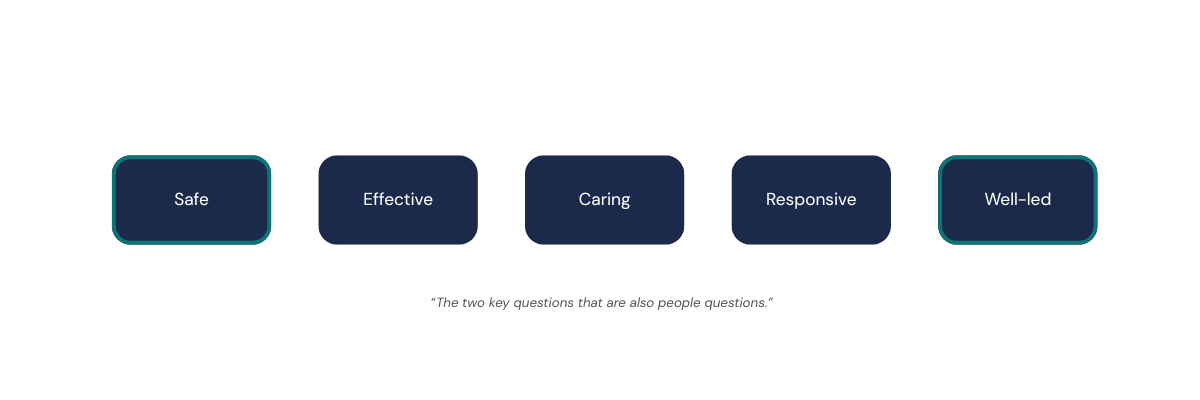
The Single Assessment Framework, now fully embedded across CQC's inspection approach, replaced periodic scheduled inspections with something more continuous. Thirty-four Quality Statements sit across five key questions: Safe, Effective, Caring, Responsive, and Well-led.
For dental practices, the framework means inspections are no longer events to prepare for. They reflect how a practice operates on an ordinary day.
The Quality Statements that most practices focus on are clinical: infection control, medicines management, safeguarding, consent. These matter and they should be in order.
But two of the five key questions, Well-led and Safe, are not only clinical questions. They are people questions. And that distinction is one that experienced inspectors understand well.
What Well-led and Safe Actually Look For
Well-led does not simply mean that a registered manager is in post and a set of policies exists in a folder. It asks how the practice is actually led day to day.
Whether concerns are raised and what happens when they are. Whether team members feel able to speak up. Whether there is a culture of learning when things go wrong, or a culture of blame and avoidance. Whether the people responsible for leading the team have the skills to do so, or whether they have been placed in that role without preparation or support.
Safe similarly extends beyond clinical protocols. It includes the working environment and how people within it are managed. A team member who is poorly supported, inadequately supervised, or placed in situations beyond their remit is a safety consideration, not just a management one.
Experienced inspectors can usually see the difference between a practice that functions well because of its people and one that presents well on paper but operates differently behind the scenes.
That gap tends to become visible within the first hour of a visit.
Where Most Practices Are Exposed
Most of the practices I work with are not failing on clinical governance. Their policies are largely in order. Their infection control records are maintained. Their safeguarding training is current.
Where they are more exposed is in the people layer underneath the policy.
How performance is managed when something is not right. Whether difficult conversations happen or get pushed to one side. Whether new team members are properly inducted or left to find their feet. Whether there is a clear, consistent approach to absence, conduct, and team expectations, or whether these things are handled differently depending on the day and who is involved.
Under the Single Assessment Framework, these are not background concerns. They are the substance of what Well-led is assessing.
The Pattern That Creates Risk
People issues in dental practices rarely present as formal problems from the outset.
They start with small inconsistencies. A conversation that does not quite happen. An expectation that is never clearly set. A situation that is managed one way on one occasion and differently the next.
On their own, these moments feel manageable. Practices absorb them and move on.
But over time, inconsistency builds. Team members become uncertain about what is expected and what the practice will do when something is raised. Concerns stop being flagged early. Issues that could have been addressed with a brief, direct conversation become something more entrenched.
By the time a formal process begins (a grievance, a disciplinary, a situation that has escalated to the point of legal risk), the roots of it are usually months old.
Practices that manage their people well are not the ones that never have difficult moments.
They are the ones with the structure and confidence to address those moments early.
What Good Preparation Actually Looks Like
Getting the people layer right does not require a complex HR function or a large policy library. It requires a small number of things, consistently in place.
- Clarity about who is responsible for people decisions in the practice and what authority they hold
- A straightforward approach to structured conversations: brief, documented, and not deferred until a situation has become formal
- A defined way of addressing concerns directly and privately, rather than in front of patients or colleagues
- A practice owner or manager who has been shown how to handle people under pressure, because this is a skill that can be learned
The practices that perform well under regulatory scrutiny are not necessarily the ones that have spent the most on HR support. They are the ones where the day-to-day management of people is clear, consistent, and handled with confidence.
A Note on Timing
With the February 2026 rejection policy now in effect and the May 2026 documentation requirements for oral health services in place, this is a reasonable moment for practice owners to consider not just whether their paperwork is in order, but whether the practice behind the paperwork would hold up to scrutiny.
Compliance on paper is not the same as a stable, well-led team. The CQC has made that distinction visible. It is likely to keep doing so.
Dental Practice People Health Check
A free structured view of where pressures and inconsistencies may already be developing in your practice team.
If reading this has prompted you to think differently about the operational side of people management in your practice, the starting point is often simpler than it appears.
Practice People Advisory works with dental practice owners in England and Wales to build the people structures that prevent small issues from becoming serious ones.
Book your Practice Discovery Call →