Something Nobody Talks About
Something happens in dental practices that rarely gets named directly.
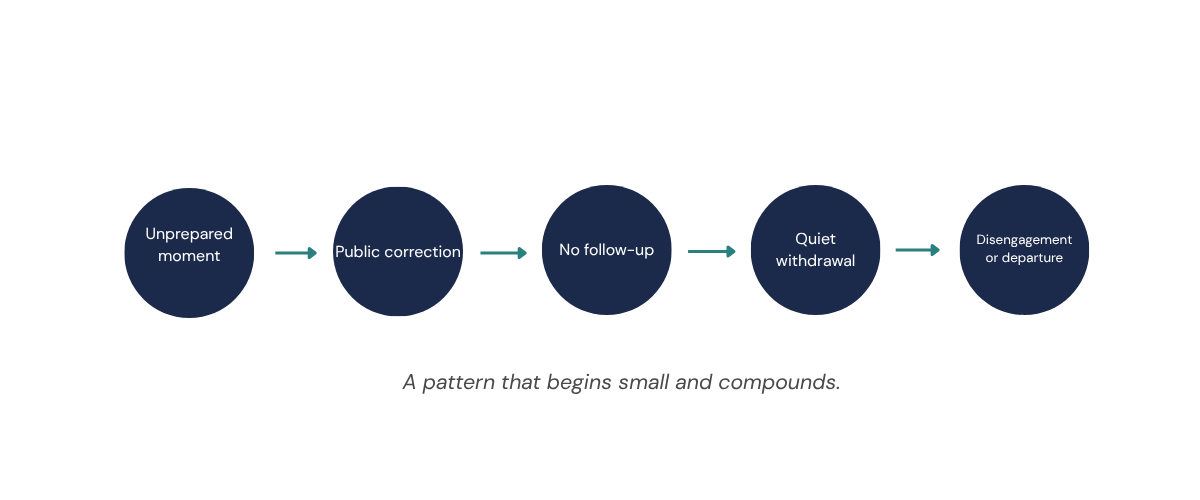
A team member is put in an impossible position. Asked to handle something they have not been prepared for, in front of a patient, with no support and no clear authority. They manage it as best they can. It is not quite enough. Someone makes that clear. Often in public.
The patient watches. The rest of the team watches. Nobody says anything.
That moment passes. But it does not go away.
It sits in the practice: in the atmosphere, in the way people speak to each other, in the team member who becomes a little quieter than they used to be. In a clinical environment where staff work in close proximity and under constant pressure, these moments land differently than they might elsewhere.
This is not a minor observation. It is one of the most consistent starting points for the people problems that eventually cost dental practices time, money, and good people.
What This Looks Like in a Dental Practice
The specific details vary, but the pattern is consistent. Common versions include:
- A receptionist or treatment coordinator expected to manage a difficult patient complaint with no guidance on what they are authorised to offer or say
- A dental nurse asked to step into a task beyond their remit, then criticised when something does not go smoothly
- A practice manager caught between conflicting instructions from clinical and business stakeholders, and blamed regardless of the direction they choose
- A new team member placed in a patient-facing situation before they have been properly inducted
What these situations share is a structural gap. The person was not set up to succeed, but when things went wrong, the response was directed at the individual rather than the gap.
The Scale of the Problem in UK Dental Practices
This pattern does not just affect individual teams. It is reflected in the wider dental workforce.
These are sector-wide figures. They reflect conditions in the practices behind the numbers, and in most cases, the contributing factors are not sudden or dramatic. They accumulate, quietly, over time.
Why These Moments Escalate
The immediate incident is rarely what causes lasting damage. What causes lasting damage is what does not happen in the days that follow.
There is no conversation
In a busy dental practice, there is rarely a natural moment for follow-up. The day moves on. The incident is not addressed. The team member is left to process it alone, and often concludes that this is simply how things work here.
There is no clear people structure
Many dental practices have not established a clear structure: who leads the team, who is responsible for addressing issues, and how that responsibility is exercised. Without that clarity, difficult moments default to whoever is most senior in the room, often mid-treatment.
Difficult conversations are avoided
Avoidance is one of the most consistent features of the practices I work with. It is entirely understandable: clinical training does not prepare people for people management, and there is rarely a safe moment in a patient-facing environment to address something sensitively. But avoidance does not resolve these situations. It compounds them.
The Real Cost to the Practice
Practice owners are often not aware of how much these moments cost. Not just in morale, but in measurable, operational terms.
Staff retention
Replacing a trained dental nurse or experienced receptionist is not a straightforward process. Recruitment agency fees alone can run into several thousand pounds. When induction time, reduced productivity, and disruption to established patient relationships are also considered, the overall cost is significantly higher. Addressing people issues early is considerably less costly than managing the departure and replacement cycle.
Quiet disengagement
Quiet disengagement is harder to name than resignation, but often more damaging. A team member who has mentally withdrawn will reduce their discretionary effort, limit communication, and subtly shift the atmosphere, until someone hands in their notice and says they have felt this way for months.
Disengagement in dental practices is rarely loud.
It tends to show up gradually, and by the time it is visible, it has usually been present for some time.
Owner time and headspace
For many practice owners, managing people issues takes a disproportionate share of their time and attention, time that should be directed at clinical work, patient experience, or the business. The cost is not just financial. It is capacity.
What Early Intervention Actually Looks Like
Most practices recognise this pattern only in hindsight. The goal is to build the capacity to recognise it earlier, or ideally, to have the structures in place that prevent it from occurring in the first place.
That does not require a large HR function or a complex policy framework. It requires a small number of things, consistently in place:
- Clarity about who is responsible for people decisions in the practice, and what authority they have
- A straightforward approach to structured conversations: brief, documented, and not left until they become formal
- A defined way of addressing incidents directly and privately with the team member concerned, not in front of patients or colleagues
- A practice owner or manager who has been shown how to handle people under pressure, because this is a learnable skill
Most of the time, nobody in these situations is being deliberately unkind. The issue is that nobody has been shown how to handle people well. That is a fixable problem, but only if it is addressed.
Prevention Versus Crisis: How the Most Stable Practices Operate
HR support for dental practices is most often sought when things have already reached a serious point: a grievance has been raised, a disciplinary process has begun, someone is on long-term absence, or there is talk of an employment tribunal.
By that stage, the cost in time, money and team morale is already significant.
The practices that manage their teams with the least disruption are not the ones that never have difficult moments. They are the ones with the confidence and structure to address those moments early, before they settle into the fabric of the practice.
Employee relations for dental practices does not need to be complicated. It needs to be present.
Download the full guide
A structured breakdown of how these moments affect dental teams, and how to address them early.
If you are starting to notice early signs of tension, disengagement, or avoidance in your practice team, addressing them early changes how the practice operates, not just in the moment, but over time.
Practice People Advisory works with dental practice owners in England and Wales to build the people structures that prevent small issues from becoming serious ones.
Book your Practice Discovery Call →